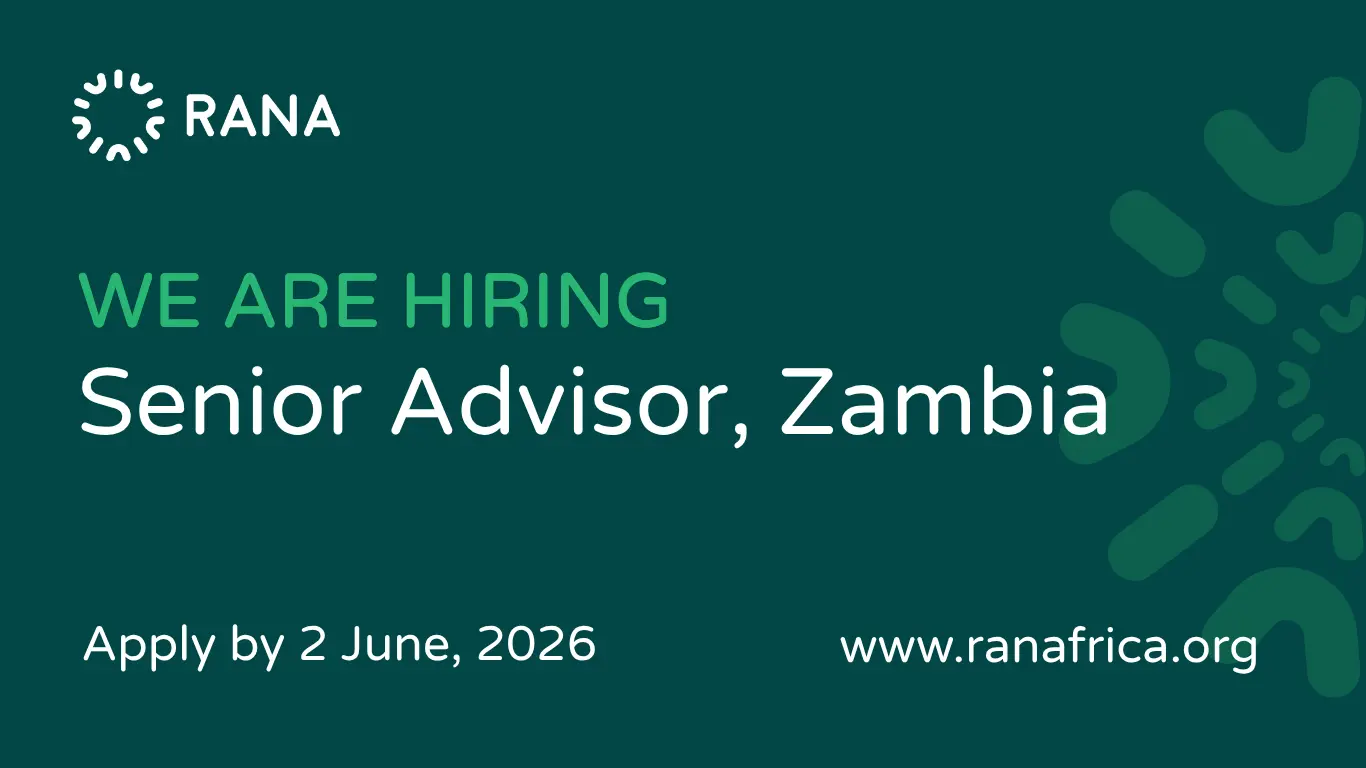
Terms of Reference: Consultant, Senior Advisor – Zambia
Terms of Reference: Consultant, Senior Advisor – Zambia
Contracts Terms and Time allocation
| Detail | Information |
|---|---|
| Time Commitment | 40% EFT |
| Contract Duration | One year, renewable dependent on availability of funding |
| Location | Zambia (Lusaka-based preferred) |
| Reporting Line | Aggrey Aluso, Executive Director, RANA |
1. About RANA
Resilience Action Network Africa (RANA) is an independent African CSO advocacy network working with partners across Africa at the national and regional level, and together with global partners, to strengthen Africa’s resilience. RANA envisions a resilient and healthy Africa, safeguarded by African-led solutions, informed by African needs, and driven by African leadership.
2. Background: Resilience in an Era of Converging Crises:
RANA works to advance the capacity of African societies to anticipate, withstand and recover from the growing convergence of climate, health and economic shocks. Across the continent, communities are increasingly confronted by overlapping crises rather than isolated events. Climate change is accelerating extreme weather, disrupting ecosystems and livelihoods thus creating conditions that heighten the risk of infectious disease emergence and spread. At the same time, global development financing is tightening, and traditional models of externally funded health systems support are becoming less reliable. These shifts highlight the urgent need for African countries to strengthen nationally owned and sustainably financed resilience systems.
Despite the rising threat of epidemics and pandemics, domestic investment in disease surveillance and early detection remains limited in many countries. The persistent burden of endemic diseases — including malaria, HIV/AIDS, tuberculosis, and cholera — understandably commands significant public health attention and resources. However, this pressure often leaves surveillance and preparedness systems under-prioritised, even though they are critical for preventing outbreaks from escalating into large-scale health emergencies.
At the same time, epidemic preparedness continues to suffer from weak political traction and competing public narratives that frame surveillance as a donor-driven or purely technical government function. Civil society and community actors therefore remain insufficiently engaged in shaping national health security priorities, limiting the political momentum required to drive sustained investment and reform.
RANA’s approach recognises that strengthening epidemic preparedness is not only a technical challenge but also a political and societal one. Building effective disease surveillance systems requires strong civic engagement, compelling public narratives, and coordinated advocacy that links epidemic preparedness to broader priorities such as climate resilience, economic stability, and national sovereignty.
Scope of Work
The Senior Advisor will work in close coordination with the RANA team to:
- Map and mobilise civil society organisations, community health networks, academic institutions, faith-based organizations, and grassroots groups engaged in health, climate, and community resilience in their respective countries.
- Establish African societies’ focused on advocacy for disease surveillance, epidemic preparedness, and health security enabling environments.
- Identify and address critical policy gaps preventing nationally led and contextualized approaches to disease surveillance and early detection.
- Conduct a narrative landscape analysis to understand existing public and political narratives around disease surveillance and epidemic preparedness and develop a strategy for shifting these narratives to generate greater political will and public demand.
- Facilitate structured civil society advocacy toward governments, regional bodies (SADC, Africa CDC), and international partners.
- Build and document a bilateral learning and coordination bridge between Mozambique and Zambia to address the transnational dimensions of epidemic and pandemic risk.
- Provide regular strategic updates at the RANA’s regional network to inform its program priorities, policy positions, and communications related to disease surveillance and epidemic preparedness.
3. Desired Qualifications & Competencies
Essential Experience
- At least 10 years of progressive leadership experience in civil society, government, or public health, climate and health nexus — with a demonstrated track record of driving policy change or institutional reform.
- Proven experience in health security, epidemic preparedness, or disease surveillance — including familiarity with integrated disease surveillance and response (IDSR) frameworks, One Health approaches, IHR (2005) implementation, and/or pandemic preparedness planning.
- Demonstrated understanding of the policy and governance landscape in Zambia, including key actors, political dynamics, and reform processes within Ministries of Health and relevant national agencies.
- Strong experience in civil society coalition building, network facilitation, and multi-stakeholder convening, particularly in health, climate, or development contexts.
- Proven experience in policy analysis, advocacy strategy development, and translating technical evidence into accessible policy asks for diverse audiences.
- Demonstrated ability to engage and influence senior government officials, international partners, and community-level actors with equal effectiveness.
- Narrative and strategic communications experience: demonstrated ability to analyze narrative landscapes, develop strategic messaging frameworks, and design advocacy communication strategies that shift public and political discourse — particularly in complex, contested, or low-salience policy environments.
Skills & Competencies
- Strategic thinking and political economy analysis: Ability to read and navigate complex political and institutional environments — including understanding why certain agendas fail to gain traction — and to identify realistic, high-leverage advocacy entry points.
- Narrative and framing expertise: Ability to diagnose narrative barriers, design counter-narratives, and coach civil society actors to communicate more effectively in service of advocacy goals.
- Facilitation and convening: Outstanding ability to design and facilitate high-quality, inclusive roundtables, strategy sessions, and multi-stakeholder dialogues.
- Communication: Excellent oral and written communications skills in English and ability to produce high-quality strategic documents, policy briefs, narrative frameworks, and reports under tight deadlines.
- Cross-cultural and diplomatic competence: Proven ability to work collaboratively and diplomatically with diverse internal and external stakeholders across cultural and organizational contexts.
- Transnational perspective: Capacity to situate national-level work within a regional and global disease surveillance and pandemic preparedness architecture.
- Attention to detail and deadline management: Disciplined, organized, and able to manage multiple deliverables simultaneously in a fast-paced environment.
4. Compensation & Benefits
The consultant will be paid a competitive day rate (40%), based on two days per week over the duration of the contract. Compensation will be negotiated based on the candidate’s experience, qualifications, and alignment with team equity principles. RANA is committed to fair and transparent remuneration.
5. How to Apply
Eligible candidates based in Zambia are invited to apply. Please submit:
- A cover letter (maximum 2 pages) clearly articulating your relevant experience, your understanding of civil society’s role in disease surveillance and epidemic preparedness, and why you are suited for this role.
- A current résumé.
- At least two professional references with relevant experience.
Send your application to: info@ranafrica.org ; copying: Aminata.wurie@ranafrica.org
6. Application deadline: 02 June, 2026
RANA is an equal opportunity employer. We strongly encourage applications from women, persons with disabilities, and candidates from marginalized communities. Only shortlisted candidates will be contacted.